Data-projects-with-R-and-GitHub
Task description
Open-source projects use commit messages to communicate intent, fixes, and changes. These short texts can reveal how teams work, how often they fix bugs, and how practices differ across repositories and time. Your task is to explore commit message styles and activity patterns across popular GitHub projects.
Questions / ideas
- How do commit volumes vary by weekday and hour, and do different repositories show distinct rhythms?
- How common are conventional commit prefixes (
feat,fix,docs,refactor,test, etc.), and how do these proportions change over time? - Are message lengths and formats different across repositories or commit types?
- Which repositories show more maintenance activity (fix/docs/chore) versus feature activity (feat)?
Data
The original dataset contains commit messages and metadata from 34
popular GitHub repositories (e.g., tensorflow/tensorflow,
pytorch/pytorch, pandas-dev/pandas) as of April 21, 2021. Source:
https://www.kaggle.com/datasets/dhruvildave/github-commit-messages-dataset/data.
The repository list is saved in datasets/source_README.md.
The commit time range varies by repository (the latest commits are as of April 21, 2021). Report the per-repo min/max dates after loading the data.
Use one of the smaller subsets provided in datasets/:
datasets/commits_sample_50k.csv(random 50,000 rows, ~28 MB) — quick prototyping.datasets/commits_sample_150k.csv.zip(random 150,000 rows, ~31 MB, zipped) — larger sample that stays under GitHub’s file size limit.datasets/commits_balanced_3k_per_repo.csv(~48 MB) — balanced sample with 3,000 commits per repo for fair repo comparison.- Raw commit-level files for three repos (large/medium/small) to build a
GitHub-style “commit calendar” heatmap. The repos are
torvalds/linux(large),pytorch/pytorch(medium), andtidyverse/ggplot2(small).datasets/commits_2019_2020_torvalds_linux.csv.zip(~42 MB, zipped)datasets/commits_2019_2020_pytorch_pytorch.csv(~13 MB)datasets/commits_2019_2020_tidyverse_ggplot2.csv(~0.1 MB)
Column overview
The CSV has the following columns:
commit: commit hashauthor: author name and email in one string (e.g.,Name <email>)date: commit date as a string with timezonemessage: commit message text (may include commas or line breaks)repo: repository inowner/nameformat
Example file: datasets/commits_sample_50k.csv
First rows (from commits_sample_50k.csv)
| commit | author | date | message | repo |
|---|---|---|---|---|
| a4ca44fa578c7c7fd123b7fba3c2c98d4ba4e53d | Joe Perches <<joe@perches.com>> | Wed May 16 09:55:56 2012 +0000 | net: l2tp: Standardize logging styles Use more current logging styles. Add pr\_fmt to prefix output appropriately. Convert printks to pr\_<level>. Convert PRINTK macros to new l2tp\_<level> macros. Neaten some <foo>\_refcount debugging macros. Use print\_hex\_dump\_bytes instead of hand-coded loops. Coalesce formats and align arguments. Some KERN\_DEBUG output is not now emitted unless dynamic\_debugging is enabled. Signed-off-by: Joe Perches <<joe@perches.com>> Signed-off-by: James Chapman <<jchapman@katalix.com>> Signed-off-by: David S. Miller <<davem@davemloft.net>> | torvalds/linux |
| 110d1943c84cdd581f152abece6d83ab0240da0f | sandromaggi <<sandromaggi@google.com>> | Thu Dec 5 10:40:48 2019 +0000 | \[Autofill Assistant\] Change form style. This CL changes the colors and text styles in the form action according to Clank UI guidelines. It also addresses the line height of the items, and increases the button touch targets to 48dp. Line heights are: 48dp, 64dp and 88dp for 1 line, 2 line and 3 line items respectively. Right align checkboxes. Before: <https://screenshot.googleplex.com/0Ues05tZuWB> After: <https://screenshot.googleplex.com/uxo8pK9AbPS> After (with checkbox): <https://screenshot.googleplex.com/K6kSqdXqpcJ> After (with radiobutton): <https://screenshot.googleplex.com/gin0KYcgaLy> 1 / 2 / 3 lines: <https://screenshot.googleplex.com/iK8wbyXNaRY> Note: This CL does not include changing the “More” toggle. Bug: b/144419528 Change-Id: Ifd60a76bbc4cb28bb78a7727f4416ce99a4a7812 Reviewed-on: <https://chromium-review.googlesource.com/c/chromium/src/+/1932783> Commit-Queue: Sandro Maggi <<sandromaggi@google.com>> Reviewed-by: Clemens Arbesser <<arbesser@google.com>> Cr-Commit-Position: refs/heads/master@{#721953} | chromium/chromium |
| 355d8a2f910508c452beedd35d41cf0e246c1bd8 | John Baldwin <<jhb@FreeBSD.org>> | Fri May 16 17:45:09 2014 +0000 | Add definitions for more structured extended features as well as XSAVE Extended Features for AVX512 and MPX (Memory Protection Extensions). Obtained from: Intel’s Instruction Set Extensions Programming Reference (March 2014) | freebsd/freebsd-src |
| f4084cf26ba956764cf96894b0a65b0d566d6a16 | Eliot Courtney <<edcourtney@google.com>> | Wed May 22 00:22:30 2019 +0000 | Use OnDragFinished instead of the presence of DragDetails for bounds reason. Clean up of DragDetails happens at a later time, so any bounds updates that occur between OnDragFinished and the deletion of the DragDetails will be incorrectly marked as a drag move or resize. drag move. Bug: b/132853334 Test: PIP window does not get stuck in the middle of the screen after Change-Id: I2f7d5db0e033768190da69e178d082f8a8fe2407 Reviewed-on: <https://chromium-review.googlesource.com/c/chromium/src/+/1614764> Reviewed-by: Mitsuru Oshima <<oshima@chromium.org>> Commit-Queue: Eliot Courtney <<edcourtney@chromium.org>> Cr-Commit-Position: refs/heads/master@{#661995} | chromium/chromium |
| 64ac5f5977df5b276374fb2f051082129f5cdb22 | Jon Maloy <<jon.maloy@ericsson.com>> | Fri Oct 13 11:04:20 2017 +0200 | tipc: refactor function filter\_rcv() In the following commits we will need to handle multiple incoming and rejected/returned buffers in the function socket.c::filter\_rcv(). As a preparation for this, we generalize the function by handling buffer queues instead of individual buffers. We also introduce a help function tipc\_skb\_reject(), and rename filter\_rcv() to tipc\_sk\_filter\_rcv() in line with other functions in socket.c. Signed-off-by: Jon Maloy <<jon.maloy@ericsson.com>> Acked-by: Ying Xue <<ying.xue@windriver.com>> Signed-off-by: David S. Miller <<davem@davemloft.net>> | torvalds/linux |
Loading zipped CSVs in R
If a file is zipped (.csv.zip), you can read it directly without
extracting:
# Example: read the 150k sample from the ZIP file
read.csv(unz("datasets/commits_sample_150k.csv.zip", "commits_sample_150k.csv"))
Data cleaning / manipulation goals
- Parse and standardize time
- Parse
dateinto a proper datetime column and deriveyear,month,weekday, andhour. - Drop rows with outlyer times, for example Unix time 0 (1970) or dates pre 2018 etc.
- Drop rows with missing or invalid
date(needed for time-based plots and annotations). - Verify that
commitis unique; drop duplicates if necessary.
- Parse
- Message parsing
- Normalize message text (trim whitespace, handle casing where needed).
- Detect conventional commit prefixes (
feat,fix,docs,refactor,test,chore,style,build,ci,perf) by checking the start of the first line only; label everything else asother.
- Filtering
- Remove auto-generated messages (e.g., “Merge”, “Bump”, “Revert”) so the statistics reflect human-written commits.
Visualization goals
- Temporal heatmap: 7x24 commits by weekday (rows) and hour (columns), overall and per repo. (Similar to commit calendar)
- Message-type comparison: stacked bar chart of commit types by repo (normalized to 100%).
- Message length comparison: boxplots of message length by repo or by commit type.
- Optional trend: monthly time series of commit types for 2–3 selected repos.
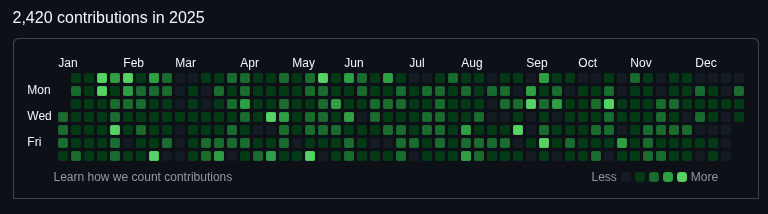
- Optional “commit calendar”: 7x53 daily heatmap (like GitHub’s
contribution graph) for 2019 and 2020 using
commits_3repos_2019_2020_daily.csv.
These visualizations connect directly to the questions above: temporal plots show rhythm and seasonality, type comparisons show maintenance vs feature focus, and length distributions highlight differences in communication style.
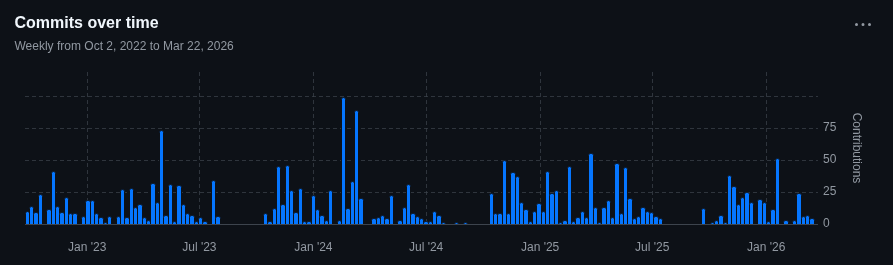
Example inspiration: GitHub Insights → Contributors → “Commits over time”.
Expected outcome
A cleaned, tidy dataset with derived time and message-type features, plus 2–3 visualizations that highlight how development patterns differ across major open-source repositories.